Stone cladding can give a building a lasting, natural finish, but quarrying and heavy transport may add environmental costs. In China, alternatives range from recycled-content panels to engineered surfaces made with plant fibers or mineral composites. Their impact depends on more than appearance. Manufacturing energy, local availability, durability, and end-of-life options matter too.
For designers asking “what is the eco-friendly alternative to traditional stone cladding,” there is no single answer. It depends on the building, climate, budget, and installation method. This guide introduces ten options available in or relevant to the Chinese market, including terracotta, reclaimed brick, recycled glass, fiber cement, and lightweight metal panels. Each has trade-offs. A recycled panel may reduce demand for virgin materials, yet still require energy-intensive production. Not every “green” claim tells the whole story.
The practical details matter. Check product data, recycled-content evidence, expected service life, and maintenance needs. Ask suppliers where materials are made and how far they travel. A lighter facade can reduce structural demands, but poor detailing may lead to repairs and waste. Samples help, too: compare surface texture, color consistency, and performance in the conditions the facade will actually face. The most responsible choice is usually the one that meets design needs and lasts, with credible information to support its environmental claims. This overview offers a starting point, not a universal ranking.
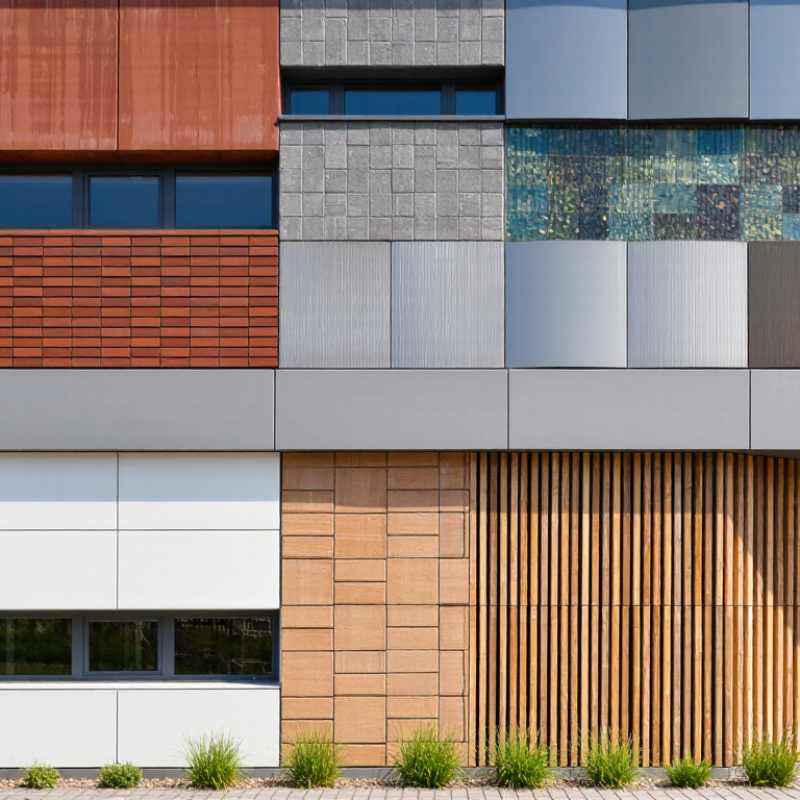
A cladding material is not eco-friendly simply because it contains recycled content or looks natural. Its impact begins with raw material extraction and continues through manufacturing, transport, installation, maintenance, and disposal. In China, shipping distance can change the footprint considerably: a lightweight panel made nearby may require less transport than a heavier imported option. But distance alone does not settle the question.
Look at the whole life cycle. Ask for independently verified environmental product data, and check what it covers. Recycled glass, reclaimed timber, and fiber-cement panels may offer useful alternatives to stone, but each has trade-offs. Some materials need protective coatings; others can be difficult to separate for recycling after installation. Durability matters, too. A panel that lasts decades with simple cleaning may outperform one that needs frequent replacement. That matters.
Performance must fit the building. In humid or coastal areas, moisture resistance and corrosion details deserve close attention. On a real project, installers also need to consider panel weight, fixing systems, and offcuts; wasted material is still part of the job’s footprint. Ask how a product handles local weather, what repairs involve, and whether its end-of-life route is practical. The evidence is sometimes incomplete. That should prompt better questions, not easy claims.
In China, stone-cladding alternatives should be assessed against the building’s climate, structure, and maintenance plan—not appearance alone. A coastal project faces salt air and driving rain; a northern site may need to withstand freeze-thaw cycles. Start with the wall assembly, including insulation, drainage, and fixing method. A lighter panel can reduce structural load, but its support system still needs careful design. Details matter.
Compare options such as terracotta, fiber-cement, recycled-content panels, and engineered surfaces using the same criteria. Ask suppliers for verified test data on water absorption, fire performance, weathering, and dimensional stability. Check whether results apply to the exact thickness and finish being specified. Also review local availability, replacement lead times, fabrication waste, and transport distance. “Eco-friendly” is not a useful conclusion by itself; recycled content may be offset by frequent replacement or difficult maintenance.
Request a full-size mock-up and inspect it after rain, cleaning, and exposure to direct sun where practical. Look closely at joints, edges, color variation, and how water drains behind the cladding. Not every sample predicts years of service. That uncertainty deserves attention. Discuss access for future repairs with the installer, and record cleaning requirements before approval. A modest material choice may perform better than a striking one when detailing and upkeep are realistic.
The options below are ranked as a practical shortlist, not a universal performance league table. Approximate weights are for the visible cladding material only, excluding subframes, insulation and fixings; actual values vary by thickness and product specification. Relative cost is indicative for comparison in China and should be confirmed through local quotations and project-specific testing.
| Rank | Cladding alternative | Typical material weight | Environmental considerations | Performance and China-specific checks | Relative initial cost | Best suited to |
|---|---|---|---|---|---|---|
| 1 | Terracotta rainscreen panels | About 30–50 kg/m² | Mineral-based and durable; kiln firing is energy-intensive. Long service life and the potential for reuse can improve whole-life performance. | Check panel anchorage, wind-load design, water drainage and freeze–thaw suitability. Include the supporting frame in structural calculations. | Medium to high | Commercial and institutional façades seeking a durable, non-combustible exterior finish. |
| 2 | Fibre-cement panels | About 15–30 kg/m² | Generally made from cement, mineral fillers and reinforcing fibres. Cement production has a significant carbon footprint; durable products may reduce replacement needs. | Specify suitable exterior-grade panels and tested fixing details. Check edge sealing, joint design, moisture exposure and local fire requirements. | Low to medium | Residential and commercial projects needing a comparatively lightweight, versatile panel system. |
| 3 | Recycled-content aluminium panels | About 5–12 kg/m² | Aluminium is highly recyclable. Recycled content can reduce production impacts, while primary aluminium is energy-intensive; request verified material data. | Confirm alloy, coating durability, panel thickness, corrosion protection and wind resistance, especially for coastal or high-rise sites. Check fire performance of the complete assembly. | Medium to high | Lightweight contemporary façades, façades with complex shapes and projects where reduced dead load matters. |
| 4 | High-pressure laminate (HPL) panels | About 8–15 kg/m² | Can provide a long-lasting finish with low maintenance. Resin content and end-of-life recycling options should be included in environmental comparisons. | Verify exterior-grade classification, UV and moisture resistance, fixing clearances and tested fire performance. Requirements depend on building height and project code. | Medium | Low- to mid-rise buildings where colour, pattern and a lightweight rainscreen are priorities. |
| 5 | Porcelain or sintered ceramic panels | About 20–35 kg/m² | Made primarily from mineral materials and typically long-lasting. Manufacturing involves high-temperature firing; local sourcing can reduce transport impacts. | Check panel size, thickness, mechanical fixing design, impact resistance and wind-load calculations. Use suitable details for humid, coastal or freeze–thaw conditions. | Medium to high | Projects seeking a stone-like appearance with low water absorption and a durable exterior surface. |
| 6 | Glass-fibre-reinforced concrete (GFRC/GRC) panels | About 30–60 kg/m² | Can use less material than conventional thick concrete elements, but cement remains a major source of embodied carbon. Compare mixes and service life. | Review panel engineering, reinforcement, connections, crack control and water management. Confirm quality control and compliance for the specific façade system. | Medium to high | Architectural façades requiring moulded shapes, textured surfaces or concrete-like finishes. |
| 7 | Brick slips or thin brick cladding | About 25–45 kg/m² | Can use less masonry material than a full-thickness brick wall. Firing consumes energy; reclaimed or locally produced units may improve resource efficiency. | Assess the backing system, mechanical restraint, moisture drainage and freeze–thaw performance. Do not assume adhered systems are suitable for every building height. | Low to medium | Residential and commercial buildings seeking a traditional masonry appearance without full-depth brickwork. |
| 8 | Responsibly sourced timber cladding | About 8–20 kg/m² | Renewable when sourced from responsibly managed forests. Long-term carbon benefits depend on sourcing, treatment, maintenance and end-of-life handling. | Choose a species and detailing suited to local humidity and rainfall. Design for ventilation and drainage, and check fire regulations, treatment requirements and maintenance intervals. | Medium to high | Low- to mid-rise projects aiming for a natural appearance and lower material weight. |
| 9 | Wood–plastic composite (WPC) boards | About 10–20 kg/m² | Some products incorporate recycled wood fibre or plastics. Their environmental value depends on verified recycled content, durability and end-of-life recyclability. | Check UV stability, thermal movement, moisture behaviour and fire classification of the tested assembly. Confirm suitability for the building height and façade location. | Low to medium | Selected low- to mid-rise façades and screened areas where a timber-like appearance is desired. |
| 10 | Coated steel or zinc façade panels | About 5–12 kg/m² | Metal panels can be recyclable, and recycled content is available for some products. Production impacts and service life depend on material, coating and maintenance. | Specify corrosion protection for inland, humid or coastal exposure. Check coating warranties, fixing compatibility, thermal movement, noise control and wind resistance. | Low to medium | Industrial, commercial and contemporary buildings where a lightweight, robust metal finish is appropriate. |
Assessment checklist: compare the full façade build-up rather than panel weight alone; request environmental product declarations or comparable lifecycle data where available; verify fire performance for the complete wall assembly; assess wind load, water drainage, thermal movement, maintenance, service life and repairability; and confirm compliance with applicable Chinese national, local and project-specific standards.
For Chinese projects, alternatives should suit local climate, supply, and installation skills. Options include bamboo-composite boards, reclaimed timber, terracotta, recycled-aluminum panels, and fiber-cement sheets. Also consider recycled-glass panels, ceramic rainscreens, lime render, rammed-earth panels, and reclaimed-brick slips. Their environmental benefits depend on sourcing, recycled content, durability, and transport distance. “Eco-friendly” is not automatic.
UNEP and the Global Alliance for Buildings and Construction reported that buildings and construction produced 37% of global energy- and process-related CO₂ emissions in 2022. That figure covers the whole sector, not cladding alone. Still, it highlights why material choices matter.
Compare product-specific environmental declarations where available, and assess maintenance, replacement, and end-of-life impacts. A lightweight panel may reduce structural loads, but coatings or difficult repairs can weaken its advantage.
Tips: Ask suppliers for verified recycled-content or lifecycle data. Check fire performance, wind-load fixing, and moisture resistance against the project design. Request a sample; touch its surface and inspect its edges. Local availability helps, but it does not prove lower impact.
Eco-friendly cladding options include terracotta, fibre cement, reclaimed timber, engineered wood, recycled aluminium, brick slips, cork, bamboo, recycled-content panels, and glass-fibre-reinforced concrete. Their performance varies. Terracotta and fibre cement handle rain well when detailed as ventilated rainscreens, while timber needs careful moisture protection and maintenance. Cork feels warm and light, but can be less impact-resistant in exposed areas. Recycled aluminium is durable, yet its production and transport can still carry substantial impacts. There is no universal winner. Details matter.
The scale is significant: the UN Environment Programme’s 2023 Global Status Report estimates buildings and construction produced 37% of global energy- and process-related CO2 emissions. That figure covers the sector, not cladding alone. For a fair comparison, the RICS Whole Life Carbon Assessment standard (2023) recommends evaluating impacts across a building’s life cycle, rather than judging materials by weight or recycled content alone. Compare quantities, transport, replacement cycles, and end-of-life assumptions. A thin panel may need extra framing; a durable, heavier option may last longer. Both can change the result. I would check project-specific environmental product declarations and local exposure conditions before ranking alternatives. Even reliable data can leave gaps, and that uncertainty deserves attention.
Choosing an eco-friendly cladding starts with the building, not a materials trend. Check the wall structure, local climate, and installer’s experience before comparing finishes. A heavy panel may need extra support, while a lightweight rainscreen can simplify installation. Rain exposure matters. So do freeze-thaw cycles and strong afternoon sun.
Timber can bring warmth and store carbon, but it needs suitable detailing and periodic maintenance. Recycled metal is light and durable, though its finish and insulation strategy affect performance. Fiber-cement panels can offer a stable, lower-maintenance surface; ask about their composition and verified environmental data. Reclaimed brick may suit a project with adequate structural capacity and a reliable supply. No option is perfect.
Compare products using evidence, not broad “green” claims. Request environmental product declarations where available, and check recycled content, transport distance, expected service life, and repair options. Then review fire performance, moisture control, and compatibility with the existing wall assembly. A small sample board helps reveal texture and color in real daylight. If possible, build a mock-up and inspect joints after rain. I have seen attractive samples look very different across a full façade; it is an easy detail to underestimate. Choose the option that fits the project’s risks, budget, and maintenance plan, even if it is not the most fashionable one.
Options include terracotta, fibre cement, reclaimed timber, cork, bamboo, recycled metal, brick slips, and recycled-content panels. No option is perfect. Performance depends on the building and its exposure.
Terracotta and fibre cement can perform well in ventilated rainscreen systems. Careful detailing helps manage moisture. Timber needs added protection and regular maintenance.
Timber can add warmth and store carbon. Its impact also depends on sourcing, transport, service life, and upkeep. Poor moisture detailing can shorten its life.
Consider the full life cycle, including material quantities, transport, replacements, and end-of-life assumptions. Recycled content alone does not tell the whole story. The data can still have gaps.
Not necessarily. It can be durable and lightweight, but production and transport may carry substantial impacts. Check project-specific environmental data.
Ask for environmental product declarations where available. Check recycled content, transport distance, expected service life, and repair options. Broad green claims need verification.
Check rain exposure, freeze-thaw cycles, and strong afternoon sun. Heavy panels may need extra support. Installer experience matters, too.
View a small sample in real daylight. If possible, build a mock-up and inspect its joints after rain. A sample can look different across a full façade; I still find that easy to underestimate.
This article explores what is the eco-friendly alternative to traditional stone cladding and how building teams in China can identify suitable options. It begins by explaining the qualities that make a cladding material environmentally responsible, including its resource use, recycled content, durability, energy demands, and end-of-life potential. It then outlines practical ways to assess alternatives in the Chinese context, considering local availability, project requirements, climate, maintenance, and installation needs.
The article introduces ten potential alternatives, such as timber, bamboo, recycled materials, and lightweight manufactured panels, and compares their performance and environmental impacts with those of stone cladding. Rather than presenting one material as right for every project, it highlights the trade-offs among appearance, weather resistance, cost, lifespan, and environmental footprint. The conclusion offers a framework for choosing cladding that fits a building’s design goals, site conditions, budget, and sustainability priorities.

Haven Decoration