Choosing the right wall finish affects daily comfort, maintenance, and long-term renovation costs. Many homeowners compare carbon crystal panels with wallpaper because both can refresh a room without major structural work. Yet their performance differs in practical ways. The question is not simply why choose carbon crystal panels over wallpaper, but which material suits the room, climate, budget, and installation conditions.
Carbon crystal panels offer a firm, smooth surface that can resemble wood, stone, or other decorative finishes. Their rigid structure may help cover minor wall unevenness and create a cleaner visual line. In kitchens, hallways, and busy family rooms, easy wiping can be valuable. A damp cloth removes many ordinary marks quickly. Installation can also be faster when panels use compatible joining systems, although careful measuring remains essential. Small errors show clearly.
Wallpaper creates warmth and visual variety. It may provide more patterns, softer textures, and lower upfront costs. However, seams can lift in humid areas, especially when the wall is poorly prepared. Replacing one damaged section may also create color differences. These concerns are not universal, and quality wallpaper can perform well with professional installation. I have seen attractive panel projects fail because installers ignored expansion space or used unsuitable adhesives. That experience deserves attention. Buyers should check product testing, moisture resistance, cleaning instructions, warranty terms, and local fire-safety requirements before deciding. Carbon crystal panels are not automatically superior, but they can be a practical, durable choice when their specifications match the space.
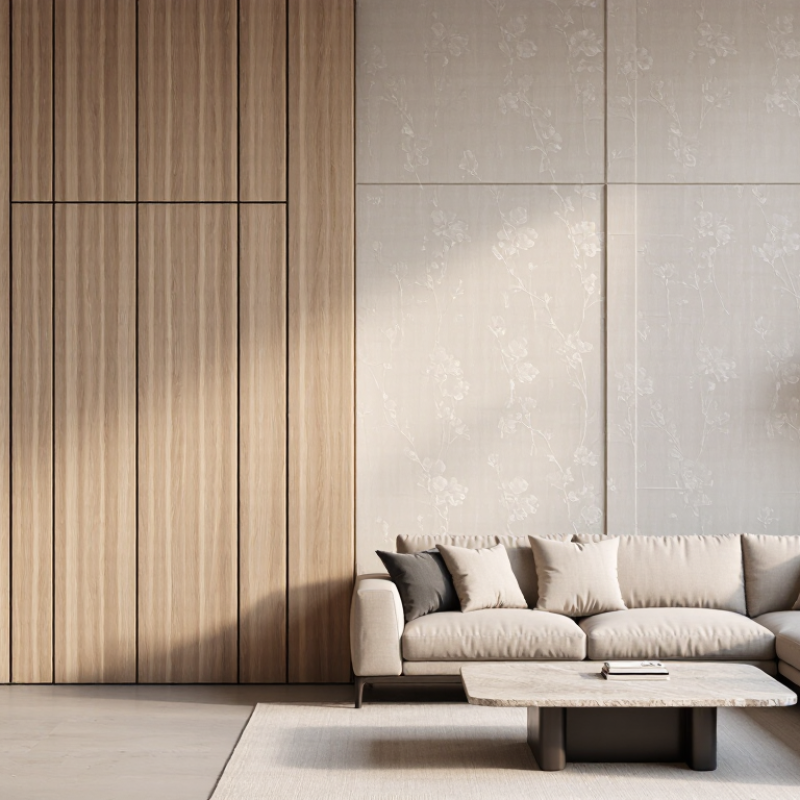
Carbon crystal panels are engineered interior boards, not simply thicker wallpaper. Their core usually combines a polymer or mineral matrix with carbon-based conductive materials. Some versions are designed as decorative wall surfaces, while others can deliver low-temperature radiant heating through embedded electrical elements. Specifications vary widely, so the name alone does not prove performance.
A useful detail is their solid, wipeable surface. In a busy hallway, a damp cloth can remove marks more easily than paper wallpaper. Many panels also use tongue-and-groove edges, reducing visible seams during installation. However, installers must check the substrate, expansion gaps, electrical safety, and fire classification. Poor preparation can create uneven joints or trapped moisture.
The International Energy Agency reported in its 2023 Global Status Report for Buildings and Construction that buildings consumed about 30% of global final energy and produced roughly 26% of energy-related emissions. That figure makes efficient heating relevant, but it does not mean every carbon crystal panel saves energy. Savings depend on insulation, thermostat control, room use, and electricity sources.
Indoor air quality also deserves attention. The U.S. Environmental Protection Agency identifies volatile organic compounds as common indoor pollutants, with concentrations often higher indoors than outdoors. Choose panels supported by independent VOC, formaldehyde, fire, and electrical test reports. I would not rely on attractive samples alone. That mistake is easy. A product may look premium yet perform poorly around corners, sockets, or humid walls.
They are engineered interior boards with a solid, decorative surface. Their core may combine polymers, minerals, and carbon-based conductive materials. The name alone proves little.
Panels are rigid and usually more resistant to peeling, bubbling, and small scratches. They can also hide uneven wall textures. Wallpaper feels softer and may cost less initially.
Usually, yes. A damp cloth can remove fingerprints, cooking splashes, and children’s marks. Avoid assuming every surface has identical resistance.
Some versions include electrical elements for low-temperature radiant heating. They may warm a room across a broad wall area. Results depend on insulation, controls, room size, and installation quality.
No. Energy savings depend on insulation, thermostat settings, room habits, and electricity sources. A heating panel is not automatically efficient.
They should inspect the wall, moisture level, expansion gaps, and electrical points. Tongue-and-groove edges can reduce visible seams. Poor preparation may create uneven joints or trapped moisture.
They may work in some humid areas, but suitability depends on the specific product. Check moisture resistance and installation requirements. A beautiful sample can still fail on a damp wall.
Ask for independent reports covering VOCs, formaldehyde, fire classification, and electrical safety. Also review operating temperatures and installation instructions. I would not trust appearance alone.
The initial cost may exceed wallpaper, especially with framing or electrical work. Longer service life could improve value over repeated replacement. That calculation is easy to get wrong.
Visible seams, color differences, poor corner finishing, and alignment issues can appear. Uneven walls often expose weak workmanship. Real homes are rarely perfectly level.
Carbon crystal panels are modern interior wall materials made from a durable, lightweight composite surface designed to provide a smooth, attractive finish. Compared with traditional wallpaper, they offer greater resistance to moisture, stains, scratches, and everyday wear, while also being easier to clean and maintain. Their structured panels can create a refined appearance without the peeling, fading, or complicated replacement often associated with wallpaper.
The question of why choose carbon crystal panels over wallpaper depends on your space, lifestyle, and design priorities. They are especially suitable for living rooms, bedrooms, offices, hallways, and other areas where long-lasting performance and simple upkeep matter. When making a choice, consider the room’s humidity, wall condition, installation requirements, desired style, budget, and expected service life. For homeowners seeking a practical, durable, and visually flexible wall solution, carbon crystal panels can provide a strong alternative to conventional wallpaper.

 Haven Decoration